
As an Amazon Associate GolferHive.com earns from qualifying purchases.
What Is A Golf Ranger Understanding Course Marshal Roles And Duties
Wondering exactly what is a golf ranger when you spot them driving around the course? Many beginners struggle to understand the actual authority and purpose of these officials. Knowing their role prevents slow play penalties and ensures a stress-free round.
A golf course ranger is a designated staff member or volunteer who patrols the golf course to manage the pace of play, enforce facility rules, and ensure golfer safety. They operate as customer service ambassadors, helping players with lost items and monitoring cart path compliance to maintain smooth operational flow.
Based on standard operating procedures from PGA of America professionals, this guide reveals the truth about their authority on the links. You will discover exactly how rangers calculate pace, what rules they enforce, and how to interact with them for a perfect round in 2026.
Key Facts
- Pace of Play Management: Rangers utilize the USGA time par formula to ensure all groups maintain appropriate gaps, keeping rounds under 4 hours and 30 minutes.
- Title Interchangeability: Industry analysis reveals that the terms golf ranger, course marshal, and player assistant are completely synonymous depending on the facility.
- Course Protection: Rangers actively enforce 90-degree cart rules to mitigate expensive turf compaction damage near putting greens.
- Modern Technology: Research indicates modern facilities increasingly supplement physical rangers with GPS geofencing on carts to track bottlenecks digitally.
- Compensation Reality: Studies show a massive percentage of the industry relies on volunteer rangers who exchange weekly shifts for free playing privileges.
Contents
show
What Is A Golf Ranger?
A golf ranger, also known as a course marshal, is an operational staff member or volunteer responsible for overseeing on-course play, regulating the pace of play, and enforcing facility policies. Golf rangers act as customer service ambassadors who ensure safety and optimal course conditions for all players.
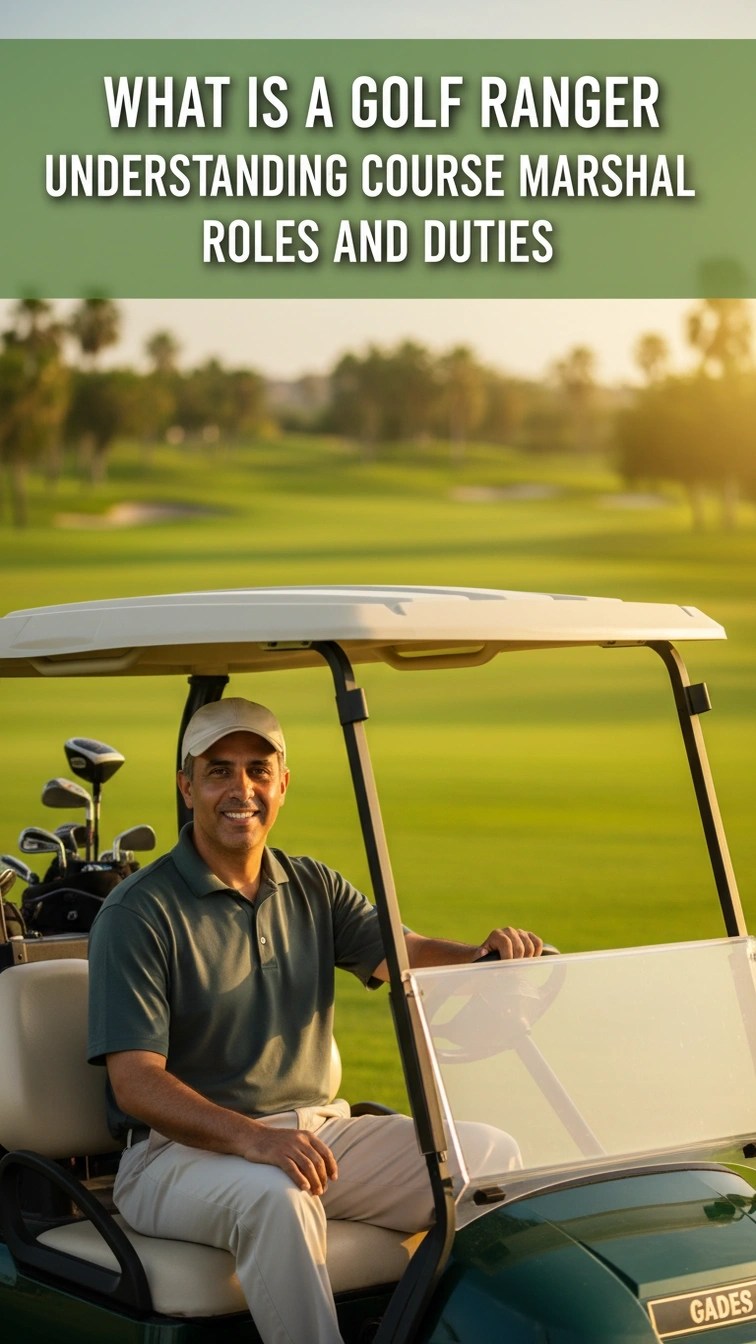
To clearly disambiguate, this position has nothing to do with a driving range, a golf rangefinder, or the “lone ranger” tournament format. Instead, this operational staff member regulates the 18-hole routing. From years of working with golf facility operations, we know these individuals are essential for maintaining harmony among dozens of groups playing simultaneously.
Their core characteristics include ⛳:
* Mobile motorized cart patrol: They constantly move across the property rather than staying at the clubhouse.
* Diplomatic customer service: They balance strict rules enforcement with a friendly, welcoming demeanor.
* Rules enforcement authority: They uphold USGA standards of etiquette and local facility bylaws.
If you are just learning golf course etiquette for beginners, understanding what to expect at a golf course starts with recognizing these key staff members. Their primary goal is simply to ensure everyone enjoys their round without unnecessary delays.
What Is The Difference Between A Golf Starter, Ranger, And Marshal?
While a golf starter controls the first tee sheet, a golf ranger patrols the 18-hole routing to manage the pace of play. Note that the titles “golf ranger,” “course marshal,” and “player assistant” are completely interchangeable, with specific usage depending solely on the facility’s preference or private vs. public status.
The golf facility staff hierarchy can sometimes confuse amateur players. A golf course starter sits stationary at the first tee (or occasionally the 10th tee), collaborating with the ranger to initiate play. They set the initial interval between groups, typically spacing tee times 8 to 10 minutes apart.
In contrast, the course marshal monitors that gap throughout the entire round. Private country clubs frequently prefer the prestigious title of “marshal” or “ambassador,” while public daily-fee courses typically use “ranger” or “player assistant.” Regardless of the name on their nametag, their operational duties remain identical.
| Feature/Role Aspect | Golf Course Starter | Golf Course Ranger / Marshal |
|---|---|---|
| Primary Location | Stationary at the 1st Tee (or 10th Tee) | Mobile via golf cart across all 18 holes |
| Core Responsibility | Managing tee sheet and dispatching groups | Monitoring pace of play and course etiquette |
| Pace of Play Role | Sets the initial interval (e.g., 8-10 minutes) | Maintains the interval throughout the round |
| Customer Interaction | Pre-round briefing and welcoming | In-round assistance and rule enforcement |
| Alternative Titles | 1st Tee Host, Starter | Course Marshal, Player Assistant, Ambassador |
Knowing this difference helps immensely when understanding tee times and pairings. It also prepares you by clarifying exactly what does the starter do at a golf course before you even hit your first drive.
What Are The Core Responsibilities Of A Golf Course Ranger?
A golf course ranger’s core duties include:
1. Pace of Play Monitoring: Ensuring groups maintain appropriate gaps and adhere to time par.
2. Course Etiquette Enforcement: Enforcing cart path rules, dress codes, and divot repairs.
3. Golfer Assistance: Helping locate lost clubs, providing course directions, and answering questions.
4. Safety Management: Enforcing lightning delays and responding to on-course emergencies.
Based on standard operating procedure golf operations, a golf course ranger’s primary duty is monitoring the pace of play to ensure all groups complete their round within the facility’s designated time par. Rangers also enforce course policies like the 90-degree cart rule, ensure golfers repair pitch marks, and serve as first responders during medical or weather emergencies.
Replacing vague job descriptions with actual daily tasks reveals how complex this role truly is. They act as the eyes and ears of the golf course superintendent and the head golf professional, creating a comprehensive network of on-course management.
How Do Rangers Monitor And Enforce Pace Of Play?
Golf rangers manage pace of play by monitoring the gap between groups rather than just overall time. If a group falls more than one hole behind the group ahead of them, the ranger will issue a warning or require them to skip a hole to restore the course flow.
Using the USGA pace of play policy guideline, rangers look for groups that are out of position. For example, if Group A is on the 4th tee and Group B is still on the 2nd green, Group B is actively eliminating course bottlenecks by playing too slowly.
Rangers utilize a time par methodology to verify these gaps objectively ⏱. When confronting a 5-hour round pace, a knowledgeable ranger will diplomatically ask the group to adopt what is ready golf in golf. If groups refuse to speed up, the ranger has the authority to intervene directly, preventing slow play delays for the entire field.
How Do Rangers Protect Course Conditions And Enforce Etiquette?
Golf rangers protect the course’s agronomic health by enforcing the 90-degree cart rule, ensuring carts stay away from greens, and reminding players to repair ball marks and replace divots. They serve as a vital course etiquette enforcer.
Cart tires compact the soil near greens, causing expensive agronomic damage over time. To prevent this, the ranger acts as a cart path compliance monitor. They will actively stop players who drive their buggies into restricted areas, mitigating golf cart turf damage.
Beyond carts, rangers look for unraked bunkers and unfixed pitch marks. They educate players on proper bunker rake etiquette in golf and golf course flagstick etiquette. The most common infractions they address include:
* Driving carts past the restricted signs near putting surfaces.
* Failing to repair deep pitch marks on the greens.
* Leaving large, unreplaced divots in the fairway landing zones.
What Is The Ranger’s Role In Course Safety And Emergency Protocols?
During severe weather or medical emergencies, golf course rangers act as first responders. They are responsible for sounding severe weather alarms, ensuring all golfers safely evacuate the course during lightning delays, and guiding emergency medical services to injured players.
Following the golf club governance handbook and golf car safety standard ANSI z130.1, the ranger holds absolute authority during a crisis. Imagine evacuating a fully booked 18-hole course during a sudden thunderstorm; the ranger uses a two-way radio to coordinate the entire retreat.
They safeguard golfers from lightning strikes by clearing the furthest holes first. They also manage frost delays in the morning, clearly explaining why golf courses have frost delays to eager golfers waiting at the clubhouse.
How Do Modern Golf Facilities Manage The Flow Of Play?
Modern golf facilities manage pace of play by establishing a USGA time par for each hole and utilizing GPS geofencing on golf carts. This technology allows course operators to track group speeds digitally, directing human rangers only to specific bottlenecks rather than relying on random course patrols.
Certified golf course manager insights reveal a massive shift in how the industry handles the flow of traffic. Rather than just driving around and telling players to hurry up, modern pace management relies on advanced tee sheet optimization algorithms and precise interval scheduling (such as 8 vs 10 minutes).
This scientific approach connects handicap system and pace of play metrics. It removes the emotion from rules enforcement, allowing the facility to lean on objective data rather than subjective observation when applying the rules of golf lost ball search time limit.
What Is The USGA Time Par Formula?
The USGA Time Par formula calculates the exact expected completion time for a round of golf by assigning specific minute values to holes based on their par, length, and difficulty. Golf rangers use this mathematical baseline to determine if a group is objectively playing too slow.
This hole by hole expected completion time removes the guesswork from monitoring. Course rating and slope difficulty impacts how many minutes are assigned. For example, a standard layout might allocate 13 minutes for a Par 3, 15 minutes for a Par 4, and 17 minutes for a Par 5.
Understanding tee times and pairings relies on this math. Losing just 1 minute per hole equals an 18-minute delay for the entire course by the end of the round. The ranger uses this formula to prove to a slow group exactly how far behind they have fallen.
How Do Human Rangers Compare To GPS Cart Tracking Technology?
While traditional golf rangers physically patrol the course to monitor pace, modern golf facilities increasingly use GPS cart tracking software to monitor groups digitally. The technology allows clubhouse staff to see exact bottlenecks on a screen, dispatching a human ranger only when specific intervention is required.
Systems like Tagmarshal automated pace tracking provide a digital tee sheet monitoring alternative to the physical course patrol. Think of this GPS cart tracking vs human golf ranger dynamic like air traffic control versus a traffic cop on the street. The software sees the whole board at once.
Furthermore, GPS geofencing can automatically shut down a golf cart if it drives too close to a green, instantly solving etiquette breaches. However, this technology only tracks the carts. Walking golfers still require a diplomatic human ranger to observe their pace and enforce rules properly.
How Do You Become A Golf Course Ranger?
To become a golf course ranger:
1. Learn the Game: Understand USGA rules, pace of play, and basic golf etiquette.
2. Inquire Locally: Visit local public courses and country clubs ahead of the spring golf season.
3. Prepare for Customer Service: Highlight your ability to de-escalate conflict and communicate clearly.
4. Understand Compensation: Be prepared to accept minimum wage or work as a volunteer in exchange for free golf rounds.
To become a golf course ranger, applicants typically need strong customer service skills, a basic understanding of USGA rules, and the ability to handle conflict diplomatically. While some rangers are paid hourly minimum wage employees, many are volunteers who exchange their time for free golf playing privileges at the facility.
For retirees, students, or job seekers, this seasonal golf employee position offers a unique way to enter the golf industry. Let’s explore the reality of what qualifications are actually required and how much a golf course ranger makes in practice.
What Qualifications And Skills Are Needed?
The most important qualification for a golf course ranger is diplomatic customer service and conflict de-escalation skills. While a high level of golf skill is not required, rangers must have a solid understanding of USGA rules, course etiquette, and pace of play guidelines.
Golf course superintendents rarely care about your golf handicap. Instead, they look for an observant course observer who can manage angry players without ruining their day. De-escalation training for golf staff is highly valued.
Key traits hiring managers look for include:
* Diplomacy: The ability to enforce rules with a smile.
* Golf Knowledge: Understanding when a group is truly out of position.
* Reliability: Consistently showing up for early morning weekend shifts.
Do Volunteer Golf Rangers Get Free Playing Privileges?
Many public golf courses operate on a volunteer ranger system, where individuals work one or two shifts a week in exchange for free golf playing privileges rather than an hourly wage. Paid golf rangers generally earn near minimum wage but often receive discounted meals, free range balls, and complimentary rounds during off-peak hours.
When comparing a volunteer ranger vs paid ranger, the volunteer golf ranger perks and benefits often outweigh the average hourly pay for a golf course ranger. A retiree who plays three times a week can easily save thousands of dollars a year by volunteering for a single six-hour shift.
It is important to note that tax laws have changed how some municipal courses classify these roles, but the barter system remains an industry standard. You trade your time managing the course for the freedom to play it.
How Should Golfers Interact With A Course Marshal?
If a golf ranger approaches your group about slow play, follow these steps:
1. Listen politely: Acknowledge their warning without arguing.
2. Check the gap: Look ahead to see if you have lost pace with the group in front of you.
3. Play Ready Golf: Stop searching for lost balls after 3 minutes and hit when ready.
4. Comply with instructions: If asked to pick up your balls and move to the next tee, do so immediately.
When approached by a golf course marshal about slow play, golfers should respond politely, avoid arguing, and immediately adopt “ready golf” practices to catch up to the group ahead. Ignoring a marshal’s instructions can result in being forced to skip a hole or, in extreme cases, being removed from the facility.
Knowing what should you do when a golf ranger approaches you comes down to proper golf etiquette compliance. From first hand golf course marshal experience, we know their goal is never to ruin your day. They are simply trying to maintain the flow of play for the groups behind you.
If you are wondering how to deal with a rude golf course marshal, the answer is always compliance in the moment. You can report unprofessional behavior to the Head Golf Professional after your round, but arguing on the fairway only exacerbates the delay. Remember the rules of golf lost ball search time limit (3 minutes) and apply what is ready golf in golf to quickly close the gap.
FAQs About what is a golf ranger
Can a golf ranger kick you off the course?
Yes, a golf ranger has the authority to remove you from the course for severe infractions, though they usually require approval from the Head Golf Professional or General Manager. Rangers act as the enforcement arm of the facility. If a golfer repeatedly refuses to maintain pace of play, damages course property, acts aggressively, or violates safety protocols (like alcohol policies or lightning warnings), the ranger will escort them off the property without a refund.
Can a golf course ranger penalize strokes?
No, a golf course ranger cannot assess penalty strokes to your scorecard during casual play or official tournaments. In casual play, golfers keep their own score. During a sanctioned tournament, only designated USGA rules officials or the tournament committee can assess penalty strokes for slow play or rules infractions. The ranger’s role is strictly to manage the facility’s operational flow, not to act as a referee for the Rules of Golf.
What is the “lone ranger” golf tournament format?
The “Lone Ranger” golf format is a specific tournament game type and has nothing to do with the job of a golf course ranger. In this 4-person team format (also known as Yellow Ball or Devil Ball), one player is designated as the “lone ranger” on each hole on a rotating basis. The lone ranger’s score is automatically counted, combined with the lowest score of the remaining three players, to create the team score for that hole.
Do golf course rangers get tips?
Generally, golf course rangers do not receive tips, as their role is authoritative and observational rather than a direct personal service. Unlike bag drop attendants, caddies, cart girls, or starters—who frequently receive cash tips for handling your equipment or serving food—rangers manage the course flow. However, players at private country clubs may occasionally include rangers in the club’s annual holiday employee gratuity pool.
What tools and equipment does a golf ranger use?
A golf ranger relies on a motorized golf cart, a two-way radio, and a timing device (watch or smartphone) to execute their duties. The radio is critical for constant communication with the pro shop, starter, and maintenance crew. Rangers may also carry extra scorecards, pencils, a first aid kit, sand/seed mix to fill divots, and sometimes a clipboard with the daily tee sheet to identify specific groups.
Do private country clubs have rangers?
Yes, private country clubs employ rangers, though they almost exclusively refer to them as “Course Marshals” or “Course Ambassadors.” At a private club, the marshal’s approach is highly diplomatic, as they are dealing with paying members rather than public daily-fee guests. Private club marshals focus heavily on member services, such as searching for lost balls, providing course condition updates, and gently reminding members of club bylaws.
Can a ranger ask a high handicap golfer to skip a hole?
Yes, a ranger can require any golfer—regardless of their handicap—to pick up their golf ball and skip to the next tee if they have fallen severely out of position. High handicap (beginner) golfers are welcome on most courses, but they are still required to keep up with the group ahead of them. If a group cannot close the gap through “ready golf,” skipping a hole is the standard facility protocol to restore course flow.
What is an acceptable pace of play for 18 holes?
An acceptable pace of play for 18 holes typically ranges from 4 hours to 4 hours and 30 minutes, depending on the course’s length, difficulty, and tee time intervals. Golf facilities calculate a specific “Time Par” for their layout. A ranger expects a group of four to complete a par-3 in roughly 12-14 minutes, a par-4 in 14-16 minutes, and a par-5 in 17-19 minutes.
Is being a golf ranger a stressful job?
Being a golf ranger can be stressful, primarily due to the conflict resolution required when confronting slow or unruly golfers. While driving a cart around a beautiful golf course seems relaxing, rangers are often the bearers of bad news. Telling a group that they are playing too slow, enforcing cart path restrictions, or dealing with intoxicated players requires thick skin, immense patience, and strong de-escalation skills.
Do golf rangers carry radar guns?
No, golf rangers do not use speed radar guns on golf carts, though this is a common myth. Instead of radar, modern golf facilities use GPS telematics (geofencing) installed on the golf carts themselves. This GPS software tracks the cart’s exact location, pace history, and alerts the clubhouse if the cart drives into restricted areas. The ranger relies on this GPS data or physical observation, not handheld radar.
Key Takeaways: Golf Ranger Summary
- Primary Function: A golf course ranger (or course marshal) is an operational staff member tasked with monitoring pace of play, enforcing course etiquette, and ensuring golfer safety across the 18-hole routing.
- Title Interchangeability: The terms golf ranger, course marshal, and player assistant are identical in function, whereas a golf starter is a distinctly different role focused solely on managing the first tee sheet.
- Pace of Play Authority: Rangers use the USGA Time Par formula to monitor the gaps between groups. They possess the authority to issue warnings or force slow groups to skip holes to maintain course flow.
- Course Protection: Rangers enforce agronomic protections, including the 90-degree cart rule, keeping carts away from greens, and ensuring players repair divots and pitch marks.
- Job Compensation Reality: While some rangers are paid minimum wage, a massive percentage of the industry relies on volunteer rangers who exchange one or two weekly shifts for free golf playing privileges.
- Golfer Etiquette: If approached by a ranger about slow play, golfers should politely comply, adopt ready golf practices immediately, and never argue with the facility’s enforcement staff.
- Modern Evolution: Many premium facilities now supplement human rangers with GPS cart tracking technology, allowing clubhouse staff to monitor bottlenecks digitally and dispatch rangers only when necessary.
Final Thoughts on Golf Course Rangers
Ultimately, a golf course ranger is essential for maintaining the operational flow and enjoyment of a golf facility. By managing pace of play and enforcing etiquette, rangers ensure that all golfers have a safe, timely, and high-quality experience on the course.
Without these dedicated staff members, a relaxing four-hour round could easily stretch into a frustrating six-hour ordeal. They bridge the gap between clubhouse management and the player experience, balancing strict rules enforcement with welcoming hospitality. While their interventions might occasionally sting a slow-playing group, their presence benefits the entire ecosystem.
The next time you tee it up, remember that the ranger is not there to act as a “golf cop” looking to ruin your day. They are customer service ambassadors working hard so that you, and every group behind you, can enjoy the game the way it was meant to be played. Treat them with respect, follow their guidance, and focus on hitting your next great shot.
