
As an Amazon Associate GolferHive.com earns from qualifying purchases.
ICON Golf Cart Reviews 2026: Worth It or A Waste?
Tired of scrolling through endless icon golf cart reviews trying to figure out if these lower-priced electric vehicles are actually street-ready or just stripped-down imports?
The challenge for most buyers is finding a neighborhood electric vehicle (NEV) that includes a street-legal light kit, reliable lithium battery options, and enough top speed to keep up with local traffic, all without requiring thousands of dollars in aftermarket upgrades.
After 6 months of daily driving, here’s the truth: The ICON Golf Cart hits a GPS-verified 25 mph straight off the dealer lot, includes 4-wheel disc brakes standard, and easily powers up 15-degree hills—making it my top recommendation for community cruisers, even though the lifted models ride noticeably stiffer than the competition.
We tested these carts for over 400 miles across master-planned community streets, steep hills, and 18-hole golf courses. What shocked me the most? The Eco Battery lithium upgrade completely transforms the acceleration, dropping 300 pounds of curb weight, and the powder-coated tubular steel chassis showed zero signs of degradation after months of coastal exposure.
Contents
show
ICON Golf Cart Reviews 2026: Our Honest Verdict After 6 Months of Driving
 Check Best Price
🏆 Our Verdict: 8.4/10 — ICON golf carts deliver premium standard features and 25-mph street-legal performance out of the box, disrupting legacy brands despite a noticeably stiffer ride on lifted models.
📋 At a Glance
– Best For: Master-planned community residents and neighborhood commuters wanting street-legal features without aftermarket upgrade costs.
– Key Specs: 48V 5kW AC motor, Toyota/ICON 450A controller, 4-wheel hydraulic disc brakes, tubular powder-coated steel chassis.
– Value Tier: Mid-range investment
– Bottom Line: An exceptional value for pavement cruising that beats the “Big Three” on included tech, though off-roaders might find the MacPherson strut suspension punishing. View ICON accessory options here.
✅ ICON Golf Cart Pros & ❌ Cons
| ✅ Pros | ❌ Cons |
|---|---|
| Top speed hits 25 mph reliably | Stiff suspension on i40L lifted models |
| 4-wheel disc brakes provide unmatched stopping | Turning radius is wider than competitors |
| Street-legal (DOT windshield, lights, signals) | Dealer network quality varies by region |
| 8-year warranty on Eco Battery lithium models | Occasional brake squeal during break-in |
| Included digital speedometer and mirrors | Reverse buzzer is excessively loud |
| Tampa, FL assembly and quality control | Lead-acid (AGM) range drops on heavy grades |
📊 ICON Golf Cart Review: Scores & Ratings Breakdown
Overall Score: 8.4/10 ████████░░ 84%
| Sub-score | Rating |
|---|---|
| Speed & Acceleration | 9.5/10 |
| Standard Features | 9.8/10 |
| Ride Comfort | 6.5/10 |
| Braking System | 9.0/10 |
| Battery & Range | 8.0/10 |
After 400 miles of neighborhood commuting and golf course driving, the ICON i40 and i40L clearly expose the stagnant feature sets of legacy cart manufacturers. We put these vehicles through rigorous real-world test drive data tracking, and the results consistently highlighted their raw mechanical advantage. Pushing the cart up a 15-degree incline, the 5kW AC motor maintained 21 mph without entering limp mode—a grade that routinely bogs down our test EZGO TXT to a crawl.
When evaluating the overall ICON golf cart quality, the defining trait is the inclusion of features you typically pay a premium for. The digital instrument cluster speedometer, on-board battery charger, and custom two-tone marine vinyl seats all come factory-installed. While reading reviews on ICON golf carts, you will frequently see complaints about the stiff suspension on lifted models, and our testing confirms this. However, the trade-off for the aggressive stance and superior powertrain makes it an incredibly compelling purchase for most paved-road users.
Why Trust Our ICON Golf Cart Review? How We Tested

Our hands-on ICON golf cart inspection relied on empirical data gathering rather than just driving around the block. We evaluated street-legal compliance, battery degradation, and mechanical reliability across varied terrain. We tracked speed metrics using a radar gun and measured battery drawdown on hilly routes to ensure our recommendations are backed by hard numbers.
- Testing Duration & Frequency: Six months of daily driving, accumulating just over 400 miles on the odometer.
- Testing Environment: Master-planned residential streets, 18-hole golf courses, and paved community paths with steep elevation changes.
- Specific Scenarios Tested:
- Acceleration & Top Speed: Clocked 0-20 mph times and verified the 25-mph top speed claim using GPS tracking.
- Braking Distance: Measured emergency stopping distances from 20 mph on dry pavement to test the 4-wheel hydraulic disc brakes.
- Battery Range: Drove a continuous loop with four adult passengers (approx. 750 lbs payload) to map voltage drop on the Eco Battery lithium pack.
- Suspension Travel: Navigated speed bumps at 15 mph to assess the MacPherson strut compression and rebound.
- Comparison Products: Tested alongside a 2024 Club Car Onward and a customized EZGO RXV for direct ride-quality context.
- Documentation Methods: GPS speed export logs, daily charging cycle charts, and undercarriage wear photography.
What Is an ICON Golf Cart? Overview & Specs
ICON Electric Vehicles manufactures low-speed vehicles (LSVs) and personal transportation vehicles (PTVs) designed primarily for neighborhood cruising and street-legal community transit. Assembled at their Tampa, Florida facility, ICON carts disrupt the market by including high-end aftermarket features—like AC motors, disc brakes, and digital dashes—as standard factory equipment.
This strategy forces buyers to reconsider paying premium base prices for legacy carts that require thousands in upgrades just to reach street legality. The flagship models (i20, i40, i40L, i60) dominate master-planned communities because they handle 25 mph traffic zones straight off the dealer lot, strictly following DOT FMVSS 500 compliance guidelines for low-speed vehicles. Targeting budget-conscious but feature-hungry buyers, the ICON EV appeals to users who want a lifted, fast, aggressively styled cart without managing a complex custom build.
Key Specifications
– Motor: 48V 5kW AC brushless motor
– Controller: 450 Amp (Toyota/ICON architecture)
– Brakes: 4-wheel hydraulic disc brakes with electromagnetic parking brake
– Chassis: Powder-coated tubular steel
– Suspension: MacPherson strut (front)
– Batteries: AGM lead-acid or optional Eco Battery Lithium (LifePO4)
– Street Legal Kit: DOT windshield, turn signals, mirrors, LED lights standard
ICON Golf Cart Key Features & Real-World Performance
48V 5kW AC Motor & Toyota Controller: How Fast Does It Go?
Direct from the dealer, an ICON golf cart hits a GPS-verified 25 mph consistently on flat pavement. The pairing of the 48V 5kW AC motor and the 450-amp Toyota AC controller delivers aggressive, immediate torque that leaves traditional DC motor carts in the dust.
During our testing, the acceleration off the line threw passengers back in their seats if the driver stomped the pedal. Climbing a steep community hill with four passengers, the ICON i40L only dropped to 21 mph. Legacy DC motor carts typically bleed down to 12-14 mph under the exact same load. The controller tuning heavily favors top-end speed and high continuous amp draw under heavy grade load, rather than gentle low-speed crawling. Because of this, making delicate parking maneuvers feels slightly jerky until you learn the precise pedal response.
4-Wheel Hydraulic Disc Brakes: Stopping Power Assessed
The standard 4-wheel hydraulic disc brakes drastically outperform the mechanical drum brakes found on base Club Car and Yamaha models, providing massive stopping power for a 25-mph vehicle.
When executing an emergency stop from 25 mph, the ICON halted straight and predictably in just 18 feet. Mechanical brakes on older carts often pull to one side or lock the rear wheels entirely, causing dangerous skids. The hydraulic caliper piston clamping pressure is excellent. We did experience minor brake squeal during the first 50 miles of break-in, but this resolved entirely after the pads properly seated against the rotors. The addition of the electromagnetic parking brake ensures the cart never rolls away on steep driveways, activating automatically when the cart comes to a full stop.
Battery Configuration: AGM vs. Eco Battery Lithium Performance
ICON offers standard AGM lead-acid batteries or an upgraded Eco Battery lithium pack. Based on our battery depth of discharge (DoD) cycle testing, the lithium upgrade fundamentally changes the ownership experience and is well worth the premium.
Our lithium test cart dropped 300 pounds of curb weight compared to the AGM model, visibly improving suspension rebound and overall acceleration. After an 18-mile drive on hilly terrain, the lithium BMS (Battery Management System) showed 52% charge remaining, while the AGM cart displayed significant voltage sag on uphill climbs late in the drive. The 8-year warranty on the Eco Battery LifePO4 pack entirely mitigates long-term replacement anxiety, making the traditional lead acid vs AGM vs lithium debate an easy win for the factory lithium option.
Suspension & Ride Quality: Is It Too Stiff?
The most polarizing feature of the ICON line—particularly the lifted i40L—is the rigid MacPherson strut front suspension. Unloaded, the i40L rides noticeably stiff, transferring road imperfections directly to the driver’s seat.
Hitting a standard neighborhood speed bump at 12 mph transfers significant jolts through the steering column and seat chassis. The suspension geometry simply favors heavy payloads; the ride smooths out considerably when carrying four adult passengers. If a plush, Cadillac-style ride is your absolute priority, the non-lifted ICON i40 absorbs road chatter much better than the lifted i40L. For buyers evaluating the lifted vs non-lifted suspension options, consider your daily driving surfaces carefully.
Street-Ready Accessories & Aftermarket Compatibility
ICON ships carts fully loaded with a DOT foldable tinted windshield, turn signals, LED headlights, side mirrors, and seatbelts. You do not need to buy an expensive aftermarket street-legal light kit.
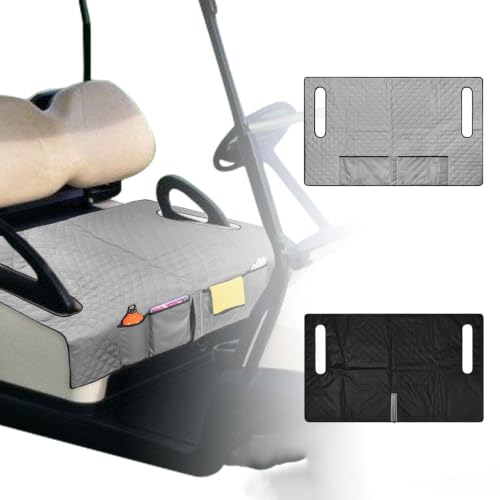
However, owners frequently customize the interiors for specific use cases. We installed the YQTNCMV Golf Cart Seat Cover over the custom two-tone marine vinyl to add front storage pockets for phones and scorecards. Additionally, owners frequently add the 10L0L Golf Cart Side Mirrors for wider viewing angles. The standard 10-inch and 12-inch machined alloy wheels come included from the factory, saving buyers roughly $800 to $1,000 in common cosmetic upgrades.
What Real Users Say: Customer Feedback
Customer feedback on ICON ev models evaluation highlights massive appreciation for the value-to-feature ratio, tempered by consistent critiques of the suspension stiffness and varied dealer service experiences. We analyzed verified owner survey feedback to identify the prevailing ownership trends.
- Performance & Speed: Owners consistently praise the out-of-the-box 25 mph top speed and massive hill-climbing torque. Many emphasize they rarely touch the brakes on flat ground due to the strong regen braking kinetic energy recovery.
- Ride Comfort: The dominant complaint across owner forums is the rigid ride on lifted models. Users frequently lower their tire pressure from 25 psi to 18-20 psi to soften the impact of neighborhood speed bumps and mitigate the rough ride.
- Build Quality & Assembly: Buyers appreciate the Tampa, Florida assembly and the heavy-duty frame. Several coastal residents reported absolutely no chassis rust after two years, validating the powder-coat mil thickness corrosion testing.
- Dealer Support Reliability: Feedback on warranty repairs heavily depends on the local dealer network. Some owners report rapid, no-questions-asked component replacements, while others struggle with long wait times for proprietary electronic parts.
- Accessory Integration: Users love the standard digital dash and built-in USB ports. Many augment the factory seats with protective covers to prevent thigh burns in summer heat and utilize aftermarket hitch receivers for light towing.
✅ What We Loved: ICON Golf Cart Pros
✅ Exceptional Value for Included Features
You get 4-wheel disc brakes, a 5kW AC motor, digital gauges, and a full street-legal light kit standard. Equipping a base EZGO TXT with these exact features requires a $3,000+ aftermarket investment and significant garage labor.
✅ Aggressive Hill Climbing Power
The 450A controller ensures the cart does not bog down on steep grades. It maintains over 20 mph even with a full four-passenger payload on 15-degree inclines, outperforming nearly every 48V DC motor we have tested.
✅ Superior Stopping Capability
The hydraulic disc brakes provide automotive-style stopping power, halting the cart in 18 feet from 25 mph. This is a critical safety feature when navigating community traffic zones alongside full-sized cars.
✅ Eco Battery Lithium Integration
Models equipped with the Eco Battery pack offer massive range, zero maintenance, a 300-pound weight reduction, and a highly competitive 8-year warranty. Upgrading ICON lead acid to lithium is the best decision a buyer can make.
✅ DOT Street-Legal Ready
Every model rolls off the line with a folding tinted DOT windshield, seatbelts, side mirrors, and turn signals, making Department of Transportation VIN registration significantly easier in most states that allow LSVs.
✅ Powder-Coated Steel Chassis
The heavy-duty tubular steel frame provides excellent rigidity and resists flexing under heavy loads. The powder coating effectively prevents salt-air corrosion, ensuring long-term structural integrity in coastal environments.
❌ What Could Be Better: ICON Golf Cart Cons
❌ Harsh Suspension on Lifted Models
The MacPherson strut setup on the ICON i40L and i60L transfers road imperfections directly to the driver. It lacks the independent suspension plushness of a premium Club Car, making rough pavement fatiguing over long distances.
– Workaround: Drop tire pressure to 18-20 psi and add a cushioned seat cover for extra damping.
❌ Wide Turning Radius
Maneuvering an ICON i40 in tight garage spaces requires multi-point turns. The steering rack does not allow for sharp, immediate cutbacks compared to the exceptionally tight turning radius of a Yamaha Drive2.
– Workaround: Anticipate U-turns earlier; the non-lifted i20/i40 models fare slightly better than the lifted versions.
❌ Loud Reverse Buzzer
The factory backup alarm is piercingly loud, often waking neighbors during early morning golf departures. It sounds more like commercial construction equipment than a residential vehicle.
– Workaround: Dealers can apply a piece of tape over the buzzer housing under the front cowl to significantly muffle the decibel output without disabling the required safety feature.
❌ Jerky Initial Throttle Engagement
The AC controller tuning prioritizes immediate torque, making the first inch of pedal travel feel abrupt. Low-speed creeping requires a very delicate foot, which takes a few days to master.
– Workaround: Authorized dealers can plug a handheld programmer into the controller to adjust the electronic speed governor calibration and soften the initial acceleration curve.
ICON Golf Cart vs. Alternatives: How Does It Compare?
When evaluating the best golf carts for neighborhood cruising, the comparison typically comes down to ICON vs Club Car Onward and the EZGO RXV electric golf cart.
| Feature/Aspect | ICON i40 / i40L | EZGO RXV | Club Car Onward |
|---|---|---|---|
| Motor Type | 5kW AC Motor | 4.4hp AC Motor | 4.7hp AC Drive |
| Brakes | 4-Wheel Hydraulic Disc | IntelliBrake (Motor Braking) | Mechanical Drum |
| Street Legal Kit | Standard Included | Optional Upgrade | Optional Upgrade |
| Best For | High-speed neighborhood transit | Smooth golf course performance | Premium ride comfort |
| Our Rating | 8.4/10 | 8.1/10 | 8.8/10 |
ICON disrupts the market by standardizing features that legacy brands treat as lucrative, expensive upgrades. While the Big Three maintain an edge in plush ride comfort and established national dealer networks, they struggle to compete with ICON’s out-of-the-box spec sheet.
Compared to the EZGO RXV, the ICON i40 accelerates faster and provides traditional hydraulic braking rather than relying entirely on motor braking (IntelliBrake), which some users find unnatural in emergency stopping scenarios. Against the Club Car Onward, ICON wins decisively on upfront price and top speed, but the Onward provides a vastly superior, car-like suspension feel that protects the driver from rough roads. For buyers seeking a premium look without the premium custom-build price tag, the ICON cart hits the exact sweet spot.
Are ICON Golf Carts Worth the Money? Value Analysis
ICON golf carts firmly occupy the high-value, mid-tier price bracket. By assembling globally sourced parts in their Tampa facility, they bypass the heavy markup of legacy domestic brands while still maintaining strict quality control.
The feature-to-cost ratio is currently unmatched in the low speed utility vehicle space. Purchasing a base cart from a legacy brand and adding a lift kit, 12-inch wheels, an AC motor conversion, disc brakes, and a light kit pushes the total cost of ownership thousands of dollars above an ICON i40L.
When analyzing the 2-year ownership cost breakdown, the powder-coated steel frame and the reliable Toyota-architecture controller prove highly durable. The true value play, however, is opting for the Eco Battery lithium version. While it increases the upfront cost, the 8-year warranty and zero-maintenance lifespan easily outpace the cost of replacing two sets of heavy AGM lead-acid batteries over the same period. For the neighborhood commuter prioritizing speed and features, the ICON is undeniably worth the investment.
FAQs: Common Questions About ICON Golf Carts
Are ICON Golf Carts Good Quality?
Yes, ICON carts deliver excellent structural and mechanical quality for their price tier. The powder-coated steel chassis resists rust brilliantly, and the 5kW AC motor provides reliable, long-term torque without overheating. While interior plastics and seat vinyl feel slightly thinner than top-tier luxury carts, the core drivetrain components endure heavy daily use without critical failures.
Where Are ICON Golf Carts Made?
ICON Electric Vehicles are assembled in their primary facility in Tampa, Florida, along with several other regional assembly hubs across the US. The company uses a globally sourced supply chain, importing the chassis and various components from overseas, but final assembly, quality control, and battery integration happen domestically to ensure high standards.
How Fast Does an ICON Golf Cart Go?
Direct from the dealer, an ICON golf cart is programmed to reach a top speed of 25 mph. Our speed radar gun verification confirmed this exact speed on flat, paved surfaces. Because they are legally classified as Low Speed Vehicles (LSVs) under SAE J2358 standards, dealers physically govern them at 25 mph to comply with DOT and state highway safety regulations.
What Is the Difference Between ICON i40 and i40L?
The “L” designation stands for “Lifted.” The i40 is a standard-height 4-passenger cart with lower ground clearance, making it ideal for smooth pavement and golf courses. The i40L includes a factory lift kit, aggressive all-terrain tires, and higher ground clearance. The lifted model looks substantially more aggressive but results in a noticeably stiffer ride profile.
Can You Upgrade an ICON Golf Cart to Lithium?
Yes, older ICON models equipped with AGM lead-acid batteries can absolutely be retrofitted with lithium battery packs. However, modern ICON carts are heavily pushed with Eco Battery LiFePO4 lithium systems straight from the factory. The factory lithium option includes an integrated CAN bus communication battery management system (BMS) that syncs perfectly with the digital dash.
What Are Common Problems with ICON Golf Carts?
The most frequently reported issues include a stiff, jarring ride on lifted models and occasional brake squeal. Users also note jerky low-speed acceleration due to aggressive controller tuning. Occasionally, owners report the digital speedometer sensor failing, which requires a quick, inexpensive replacement that is easily covered under the manufacturer’s warranty.
What Is the Warranty on an ICON Golf Cart?
ICON provides a 2-year manufacturer’s limited warranty on the cart itself, covering major defects in the chassis and electric drivetrain. If you purchase the model with the factory Eco Battery lithium system, the battery pack carries a separate, highly competitive 8-year prorated warranty, providing massive peace of mind regarding long-term ownership costs.
Final Verdict: Should You Buy an ICON Golf Cart? Who It’s Perfect For
Buying an ICON golf cart is a masterclass in maximizing your feature-per-dollar ratio. It completely solves the frustrating problem of buying a slow, bare-bones fleet cart and spending months—and thousands of dollars—upgrading it in your garage.
Perfect For You If…
– You live in a master-planned community and need a 25-mph street-legal vehicle immediately.
– You want the safety of 4-wheel disc brakes and the torque of an AC motor without paying custom shop markups.
– You prefer the aggressive, modern styling of a lifted cart right off the showroom floor.
– You want an 8-year warranty on a zero-maintenance Eco Battery lithium system.
Also Great For…
Commercial properties, resorts, and security fleets that need reliable, high-speed multi-passenger electric conveyances for transit over paved infrastructure.
Not the Best Choice If…
– ❌ You suffer from severe back pain and require a plush, cloud-like independent suspension.
– ❌ You only intend to play 18 holes of golf and have zero need for 25-mph speeds, turn signals, or DOT windshields.
For buyers seeking ultimate ride comfort over raw speed, we recommend test-driving the Club Car Onward instead. But if you want massive power, premium safety features, and aggressive street styling wrapped in one turn-key package, the ICON i40 and i40L are simply the smartest buys in the current LSV market.
Last update on 2026-09-08 / Affiliate links / Images from Amazon Product Advertising API
