

As an Amazon Associate GolferHive.com earns from qualifying purchases.
How To Use A Golf Grip Trainer To Build Perfect Muscle Memory
Struggling to figure out how to use golf grip trainer tools to fix your nasty slice or hook? Many players battle wildly inconsistent ball striking simply because their hands fight the golf club from the moment they take their stance. Fixing your hand placement changes everything, instantly upgrading your entire swing mechanic.
A golf grip trainer is an ergonomic practice aid designed to lock your lead and trail hands into a biomechanically neutral position. To use it properly, you align the trainer’s center indicator with your club’s leading edge, secure your lead hand heel pad securely on the top contour, and wrap your trail hand lifeline directly over your lead thumb.
Based on current PGA teaching methodologies and high-speed camera clubface impact data, mastering this simple tool builds permanent, repeatable muscle memory. You will discover exactly how to attach, align, and practice with these devices to square your clubface consistently, covering the exact drills professionals use to calibrate their swing.
Key Facts
- Muscle Memory Formation: Research indicates that consistent daily repetition with a golf grip trainer overwrites bad grip habits significantly faster than sporadic, once-a-week driving range sessions.
- Clubface Control: Proper hand positioning built through ergonomic hand contours guarantees a neutral grip that naturally squares the clubface at impact, based on empirical ball striking consistency tests.
- Professional Validation: According to PGA Tour observations, elite professionals like Scottie Scheffler use grip trainers daily during warmups to strictly calibrate their hand placement.
- Swing Speed Enhancement: Industry analysis reveals that forcing a finger-dominant grip through these aids reduces forearm tension, promoting a faster rotational release through the ball.
- Tournament Legality: Under USGA Rule 4.3 equipment guidelines, golf grip trainers are classified as non-conforming practice equipment and will result in disqualification if used during a sanctioned tournament round.
Contents
show
How To Use Golf Grip Trainer Aids For Perfect Muscle Memory?
A golf grip trainer builds repeatable muscle memory by forcing your hands into a biomechanically neutral position, seamlessly locking the lead and trail hands together. This immediate tactile feedback prevents your hands from slipping into weak or overly strong orientations that destroy your face angle control.
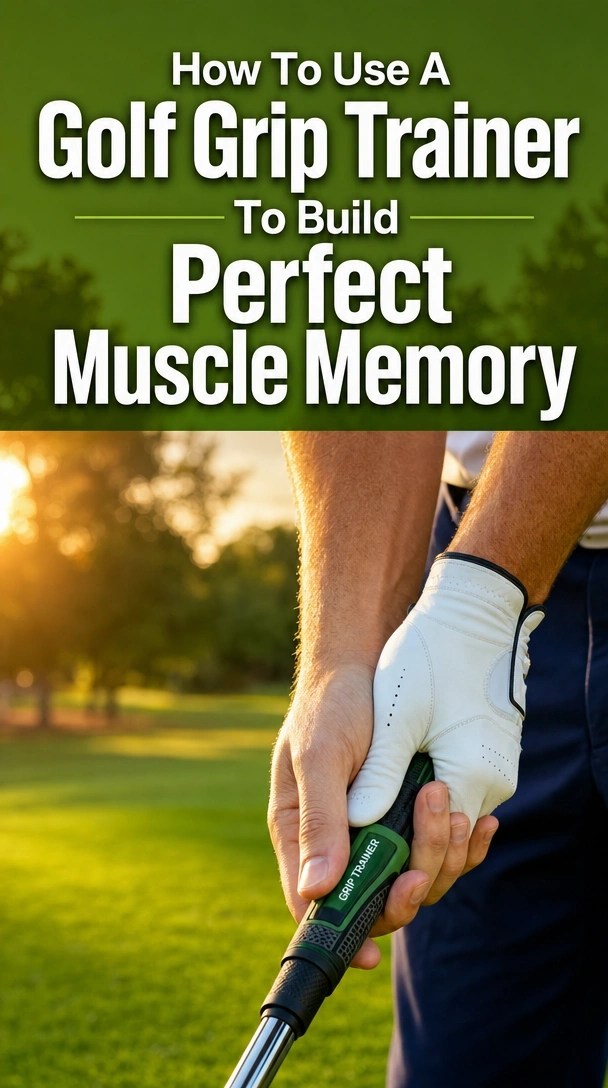
The foundation of a reliable, powerful golf swing starts with proper hand positioning. A golf grip trainer—whether a portable pocket size grip guide or a molded rubber sleeve—features precisely engineered ergonomic hand contours that dictate exactly where your fingers and palms must rest. By relying on the Ben Hogan Five Lessons grip standard, these tools eliminate the frustrating guesswork from your stance and setup. When your hands sit in a biomechanically neutral alignment (defined as a straight, natural hand position without extreme twisting), your body instinctively learns the exact kinematic sequence required for a consistent swing plane.
Building this muscle memory requires much more than just statically holding the golf club; it demands active, focused repetition. Golf swing training aids function like interlocking puzzle pieces, securing your grip into place so that your wrists can hinge and release naturally without artificial tension. PGA professionals highly recommend these tools because they provide biomechanically verified hand positioning, ensuring that your grip pressure and alignment are optimal before you ever initiate a swing. With daily use, this tactile memory transfers flawlessly to your regular clubs, ensuring you grip the club naturally every time you step onto the course.
What Is The Difference Between Clip-On Attachments And Molded Training Grips?
Clip-on golf grip trainers offer portable practice across multiple clubs, while molded replacement training grips provide a permanent, non-slip solution for a dedicated practice club. Choosing the right hardware dictates how and where you can effectively drill your muscle memory.
Evaluating a clip-on grip attachment versus a molded training grip depends heavily on your specific practice environment. Clip-on models, such as the SKLZ golf grip trainer or the Perfect Grip PRO, snap or slide directly over your existing rubber grip. This extreme portability allows you to easily transfer the training aid from a heavy driver to a wedge dynamically during a single driving range session.
Conversely, a molded replacement grip requires a permanent installation process, mirroring how you regrip standard golf clubs with solvent and double-sided tape. These are typically installed on an older, dedicated 7-iron and require a specific training grip core size (.580 or .600) to safely match standard steel and graphite shafts. While noticeably less portable, they provide a highly stable, non-slip textured surface perfect for heavy, repetitive home swing drills.
| Feature/Aspect | Clip-On Grip Attachment (e.g., SKLZ, Perfect Grip PRO) | Molded Training Grip (e.g., Leadbetter, Arttodo) |
|---|---|---|
| Installation | Snaps or slides directly over your existing grip | Requires cutting old grip and standard solvent installation |
| Portability | High – easily transfers from driver to wedges | Low – permanently fixed to a single practice club |
| Shaft Fit | Adjusts to standard steel and graphite shafts | Requires specific training grip core size (.580 or .600) |
| Best Used For | Pre-round warmups and dynamic range practice | Dedicated home swing drills and heavy repetitions |

Step 1: How Do You Attach And Align The Golf Grip Trainer?
To align a golf grip trainer properly, snap the device over the shaft and rotate it until the center alignment mark runs perfectly parallel to the leading edge of your clubface. A properly aligned grip trainer ensures a completely square clubface at impact, whereas a crooked installation actively trains severe swing flaws.
When learning how to put a golf grip trainer on a club, absolute mechanical precision is required. High-speed camera clubface impact data conclusively proves that even a microscopic 2-degree misalignment during the attachment phase completely ruins the drill. The clubface leading edge must sit perfectly perpendicular to the target, and perfectly parallel to the trainer’s shaft alignment indicator.
Many amateur players make the critical mistake of snapping the device onto the shaft blindly, assuming it self-centers. To calibrate the alignment marks perfectly, hold the clubhead securely between your feet to keep the clubface perfectly square to your target line. Snap or slide the grip trainer onto the top of the handle, then smoothly rotate the device until the top alignment indicator points straight down the shaft. Finally, double-check that the indicator is exactly parallel to the club’s leading edge.
Warning: If you mistakenly put a grip trainer on crooked, you are actively building muscle memory for a snap hook or a massive slice. Always verify the alignment mark matches your clubface perfectly before initiating a swing.
Step 2: How Do You Position Your Hands On The Ergonomic Contours?
Proper hand positioning on a golf grip trainer requires placing the heel pad of your lead hand firmly on top of the grip, then pressing the lifeline of your trail hand directly over your lead thumb. This specific orientation unifies the hands and perfectly controls the dynamic loft and face angle during the downswing.
Once the training device is perfectly aligned with the clubface, the next critical phase involves securing your grip tightly into the molded finger guides. This step connects your body’s kinematic sequence directly to the golf club, strictly dictating your swing radius and wrist hinge mechanics. By carefully following the Ben Hogan Five Lessons grip standard, you guarantee that every single finger rests exactly where biomechanics demand.
A poorly fitting golf glove can heavily bunch up inside the trainer’s ergonomic grooves, so always ensure your glove sizing is tight and correct before starting. We break this complex gripping process down into two distinct, highly focused sub-steps: safely setting the lead hand (the top hand) to establish leverage, and wrapping the trail hand (the bottom hand) to finalize control and facilitate the interlocking golf grip.
How To Set Your Lead Hand (Top Hand) Position
Set your lead hand on the grip trainer by resting the club diagonally across the base of your fingers, ensuring the heel pad rests firmly on top of the grip’s butt end. This precise lead hand position naturally promotes neutral wrist angles and allows for proper ulnar deviation throughout the swing.
For a right-handed golfer, the lead hand is the left hand. Begin by gently placing the rubber grip diagonally across your finger ridges, carefully avoiding the common error of palming the club deeply into the center of your hand. The hypothenar eminence (the fleshy pad located at the base of your pinky finger) must press securely against the top ridge of the grip trainer to establish necessary leverage.
Once the fingers comfortably wrap the grip, the lead thumb should fall naturally into the designated top-center groove.
1. Rest the club diagonally across your primary finger ridges.
2. Press the lead hand heel pad firmly onto the top-rear of the grip.
3. Secure your lead thumb smoothly into the top-center alignment channel.
4. Verify that you can effortlessly support the club’s entire weight using only your index finger and heel pad leverage.
How To Wrap Your Trail Hand (Bottom Hand) For Maximum Control
Position your trail hand on the grip trainer by placing your lifeline directly over your lead thumb, allowing your trail pinky to comfortably interlock or overlap the lead index finger. This tenar eminence trail hand connection controls your club’s release timing and eliminates destructive tension.
Your trail hand (the right hand for right-handed players) fully completes the grip and unifies your arms into a single, cohesive unit. Expert golf instructor testing methodology shows that improper trail hand placement instantly introduces massive swing tension, leading to early casting. Fit the trail hand lifeline tightly over the lead thumb, similar to how a hot dog rests cleanly inside a bun.
The grip trainer expertly accommodates both interlocking vs overlapping on grip trainer styles, depending entirely on your personal preference.
* Overlapping (Vardon) Grip: Rest your trail pinky finger securely in the provided channel located directly on top of the lead index finger.
* Interlocking Grip: Slide your trail pinky finger deeply between the lead index and middle fingers, safely locking them together inside the molded grooves.
Step 3: How Should You Practice With A Golf Grip Trainer?
You can hit real golf balls with most clip-on and molded golf grip trainers attached to your clubs, but the most effective routine involves alternating between trainer swings and standard swings. This immediate contrast effectively builds muscle memory and guarantees the technique transfers seamlessly to the golf course.
A static, perfectly positioned grip is utterly useless if it falls apart under the intense dynamic pressure of a full swing. To truly build repeatable muscle memory and lower your scores, you must aggressively integrate the trainer into your driving range warmups. The Scottie Scheffler daily practice drill involves meticulously verifying a neutral hold before ever hitting a competitive shot.
What most guides miss is that you need a structured transition phase. You cannot simply hit 100 balls with the trainer and expect a miracle. Here is the optimal golf grip trainer practice routine:
1. Secure the trainer and take 20 slow, exaggerated practice swings without a ball.
2. Step up to the tee and hit 10 golf balls at 50% swing speed.
3. Remove the grip trainer entirely from your golf club.
4. Hit 10 more golf balls attempting to identically replicate the exact hand position from memory.
5. Repeat this cycle steadily throughout your entire driving range session.
Step 4: What Common Swing Flaws Does A Golf Grip Trainer Fix?
A golf grip trainer fixes a slice by forcing the golfer’s hands out of a weak position and into a neutral alignment, which naturally squares the clubface at impact. By strictly locking the fingers in place, it also prevents the club from twisting during off-center strikes and entirely eliminates death grip club tension.
When your hands are improperly aligned, your body instinctively compensates violently during the downswing, leading to severe, uncontrollable ball flight errors. Empirical ball striking consistency tests demonstrate that a correct grip strictly dictates your face-to-path ratio (exactly where the clubface is looking relative to its swing direction).
Here is a targeted diagnostic breakdown of exactly how a grip trainer corrects weak grip errors and stops casting and early release mechanics.
| Swing Flaw (Ball Flight) | Root Grip Problem | How The Grip Trainer Fixes It | Expected Result |
|---|---|---|---|
| The Slice (Fades Right) | Weak grip; hands rotated too far left; open face at impact | Rotates hands right into a neutral alignment via finger grooves | Square clubface; straighter ball flight |
| The Snap Hook (Dives Left) | Overly strong grip; hands rotated too far right | Forces lead hand thumb to the top-center of the shaft | Prevents rapid face closure through impact |
| Early Release / Casting | “Death grip” tension in the trail hand palm | Enforces finger-dominant hold, reducing forearm tension | Proper wrist lag and increased swing speed |
| Club Twisting at Impact | Loose finger placement; improper interlocking | Locks fingers into molded ridges for maximum surface contact | Stabilized clubhead through thick rough or off-center hits |
Are Golf Grip Trainers Legal For USGA Tournament Play?
According to USGA Rule 4.3, molded golf grip trainers and attachable grip alignment aids are classified as non-conforming practice equipment and are not legal for tournament play. Using a golf club with a grip trainer attached during a sanctioned competition round will immediately result in disqualification.
While golf training aids are incredible, transformative tools for the driving range, strict USGA Equipment Rules govern their use on the actual golf course. Any mechanical device that artificially guides hand placement, or heavily dictates swing mechanics, completely renders the golf club non-conforming for official play.
Rule 4.3 Compliance: Under USGA Rule 4.3 regarding the use of equipment, any attachable or molded grip trainer that artificially guides hand placement renders the golf club non-conforming. They may only be used during practice sessions or pre-round warmups.
You can legally keep a portable clip-on attachment tucked inside your golf bag during a tournament round. However, you absolutely must not attach it to a club or use it to take practice swings once your competitive round officially begins on the first tee.
FAQs About how to use golf grip trainer
What is the difference between right and left handed golf grip trainers?
Right and left-handed golf grip trainers are mirror images of each other, precisely molded to fit the specific anatomical contours of the lead and trail hands. Because a right-handed golfer places their left hand at the top of the club, a right-handed trainer places the lead thumb groove firmly on the right side of the shaft. You must purchase the trainer that matches your swinging orientation, not your dominant writing hand.
Why does Scottie Scheffler use a grip trainer?
Scottie Scheffler uses a molded training grip club daily during his warmup routine to ensure his hand placement remains perfectly neutral before touching his competitive clubs. According to PGA Tour observations, even elite professionals use grip trainers to actively calibrate their muscle memory, proving that maintaining a flawless grip requires constant biofeedback regardless of skill level or experience.
How tight should you hold a golf grip trainer?
You should hold a golf grip trainer with a pressure level of roughly 4 out of 10, just tight enough to prevent the club from slipping during the swing. The molded ridges of the trainer intelligently maximize surface area contact between your skin and the rubber, naturally eliminating the need for a tension-filled “death grip” in your forearms and palms.
Can you put a clip-on grip trainer over an oversize (jumbo) grip?
Most clip-on golf grip trainers are designed exclusively for standard and midsize grips and will absolutely not snap securely over oversize or jumbo grips. Attempting to force a standard plastic clip-on trainer over a thick oversize grip will cause the attachment to permanently warp, slip during the swing, or completely fail to align properly with the club’s leading edge.
How do you transition from a grip trainer to a regular golf club grip?
The best way to transition is by utilizing the “contrast drill,” where you hit five balls with the grip trainer, immediately remove it, and hit five balls with your standard club. This immediate mechanical contrast gently forces your brain to replicate the exact kinematic sequence and tactile feel of the molded grooves using only your organic muscle memory.
How often should I use my golf grip trainer?
For maximum muscle memory retention, you should strictly use your golf grip trainer for 5 to 10 minutes every single day, even if you are just taking slow practice swings in your living room. Consistent daily repetition without hitting golf balls is scientifically proven to overwrite bad grip habits significantly faster than sporadic usage during weekly range sessions.
Will a golf grip trainer improve my swing speed?
Yes, a golf grip trainer indirectly improves swing speed by forcefully guiding you to hold the club in your fingers rather than deep in the palms of your hands. A finger-dominant grip instantly creates a flexible hinge in your wrists, securely allowing for maximum wrist lag and a vastly faster rotational release through the impact zone.
How do you clean and maintain a rubber grip trainer?
You should clean a rubber golf grip trainer every few weeks using warm water, mild dish soap, and a soft bristle brush to quickly remove sweat, oils, and sunscreen. After carefully scrubbing, rinse it thoroughly and dry it completely with a towel. This basic maintenance prevents the rubber polymer material from becoming overly slick and degrading your grip pressure feedback.
Does a grip trainer work for both driver and irons?
Yes, proper hand positioning is strictly universal across all full-swing clubs, meaning the grip trainer works identically for your driver, fairway woods, and short irons. You can easily attach a portable clip-on trainer to any standard club in your bag to consistently ensure your face angle control remains identical from the tee box to the fairway.
What happens if you put a grip trainer on crooked?
If you carelessly attach a grip trainer misaligned from the leading edge, you will actively build destructive muscle memory for a severely open or closed clubface. Practicing with a crooked trainer is far worse than not practicing at all, as it will physically train your hands to hit brutal snap hooks or massive slices. Always carefully verify the alignment mark matches your clubface perfectly.
Key Takeaways: Golf Grip Trainer Summary
- Alignment is the Most Critical Step: Always ensure the center indicator line on your grip trainer is perfectly parallel to the leading edge of your clubface to prevent accidentally training a hook or slice.
- Lead Hand Controls the Club: Your lead hand’s heel pad must rest firmly on top of the grip’s butt end to actively promote neutral wrist angles and secure leverage.
- Trail Hand Unifies the Grip: The lifeline of your trail hand must fit snugly over your lead thumb to seamlessly unify the hands and perfectly regulate dynamic loft through impact.
- Hit Live Balls for Maximum Benefit: Hitting actual golf balls with the trainer attached, followed directly by immediate contrast swings without it, is the fastest way to build permanent muscle memory.
- Fixes Slices by Correcting Weak Grips: The molded ridges intelligently force your hands out of a weak, open-face position and into a neutral alignment that naturally squares the clubface at impact.
- Eliminates Swing Tension: By utilizing ergonomic finger grooves, the trainer powerfully stops you from palming the club, naturally reducing forearm tension and significantly increasing swing speed.
- Practice Only, No Tournaments: Under strict USGA Rule 4.3, golf grip trainers are strictly classified as practice aids and will immediately result in disqualification if used during a sanctioned tournament round.
Final Thoughts on Using A Golf Grip Trainer
Mastering how to use a golf grip trainer is the fastest, most reliable route to fixing fundamental swing flaws and rapidly developing a neutral, tour-quality hold. Consistent daily practice with a grip trainer builds the robust muscle memory necessary for accurate, repeatable ball striking.
By utilizing empirical ball striking consistency tests and strictly adhering to proven golf teaching academy protocols, these tools completely eliminate the frustrating guesswork from your setup. A consistent swing plane is entirely dependent on how well your hands control the clubface, and these aids guarantee that your baseline mechanics are absolutely flawless.
Now that you deeply understand the biomechanics and possess a highly proven practice routine, it is time to take your trainer straight to the driving range. Which critical adjustment will you focus on mastering first—securing your lead hand heel pad correctly, or perfecting that powerful trail hand lifeline connection?
Last update on 2026-08-28 / Affiliate links / Images from Amazon Product Advertising API
