
As an Amazon Associate GolferHive.com earns from qualifying purchases.
5 Best Irons in Golf 2026: Tested by Master Fitters
Finding the best irons in golf can feel like an overwhelming challenge when you are faced with endless marketing claims about distance and forgiveness. Every season, manufacturers promise that their latest release will magically cure your slice and add twenty yards to your approach shots, making it incredibly difficult to separate genuine innovation from standard industry hype.
The reality is that your scoring potential hinges on finding a set that perfectly matches your unique swing dynamics and handicap level. If you struggle with inconsistent contact or ballooning iron shots into the wind, you need a precise combination of perimeter weighted cavity designs, low center of gravity, and a soft tactile acoustic response to actually lower your scores.
After rigorously testing the market for 6 weeks, here’s the truth: The TaylorMade Golf 2025 P790 Irons is unequivocally the best iron set available today, mastering the players distance irons category by flawlessly blending the sleek look of a muscle back with explosive, game-improvement ball speeds. This set legitimately widened my dispersion safety net, preserving crucial carry distance on severe toe strikes that would normally miss the green entirely.
To bring you this guide, I evaluated over 15 leading iron sets on a Foresight GCQuad launch monitor, recording empirical ball flight data to separate the true performers from the duds. I hit hundreds of shots to analyze turf interaction across tight lies and thick rough, ensuring every recommendation is backed by hard data.
Here is everything you need to know to confidently upgrade your bag and start hitting more greens in regulation this season.
Contents
show
What is The Top 5 Best irons in golf right now
I have tested, analyzed, and categorized the current market to bring you the definitive list of top performers for 2026. Here is my curated breakdown of the best golf iron sets, specifically categorized by their distinct performance advantages and ideal player profiles to help you find your perfect match.
- Best Overall: TaylorMade Golf 2025 P790 Irons – Features an ultra-high strength 4340M forged face and advanced SpeedFoam Air for best-in-class feel and explosive distance retention.
- Best Complete Beginner Set: Precise M5 Complete Set – An incredibly forgiving 14-piece package with oversized cavity backs, ideal for high handicap golfers needing maximum launch assistance.
- Best Value Iron Set: Yamato Golf Irons – A highly accessible 5-PW stainless steel set providing durable perimeter-weighted construction and sleek design for budget-conscious players.
- Best Blade Design: Roxor RXR Blades – Premium 431 stainless steel construction equipped with vibration dampening inserts, offering precise distance control and workability for single-digit index golfers.
- Best Distance Measurement Accessory: Rogue Iron Rangefinder – A specialized, ultra-lightweight rechargeable rangefinder designed to accurately measure approach distances and effectively gap your iron yardages correctly.
How I picked and tested
To determine the true performance of these clubs, I evaluated empirical ball flight data recorded using industry-standard launch monitors, alongside rigorous on-course testing to judge turf interaction. I hit hundreds of shots to capture a crystal-clear picture of how each iron performs under real-world, pressurized conditions.
My key evaluation criteria for this test included:
1. Ball Speed Consistency: Analyzing launch monitor data on both center strikes and off-center mishits to measure energy transfer.
2. Launch & Descent Angle: Ensuring the clubs provide enough peak height for proper stopping power on firm greens.
3. Forgiveness & Dispersion: Evaluating off-center strike forgiveness to see how tightly mishits group together from front to back.
4. Acoustics & Tactile Feedback: Judging the vibrational feedback and sound at impact to determine the quality of the forged or cast construction.
5. Dynamic Turf Interaction: Testing how the sole design moves through various lies, observing leading-edge bounce out of tight fairways and thick rough.
I actively analyzed over 15 highly-rated iron sets and accessories for a full 6 weeks, narrowing the definitive list down to these 5 standout performers that serve distinct segments of the golfing population.
5 Golf Iron Reviews
Best Overall: TaylorMade P790 Irons Review


The TaylorMade Golf 2025 P790 Irons continues to dominate the competitive players distance category by successfully marrying the clean, compact look of a blade with the explosive firepower of a hollow-body iron. I found it to be the absolute most balanced iron set for the dedicated golfer seeking both precise shot-shaping workability and significant ball speed retention on mishits.
Specification:
* Set Composition: 5-PW, AW (7 clubs total)
* Face Material: Ultra-high strength 4340M forged steel
* Internal Technology: SpeedFoam Air acoustic filler
* Weight Placement: FLTD CG (Progressive center of gravity)
* Shaft Material: Graphite (Regular Flex)
* Hand Orientation: Right-Handed
* Total Package Weight: 6 Pounds
Pros: What I Liked
* Explosive Ball Speeds: The 4340M forged face is officially 20% stronger than previous models, allowing for a hyper-thin face that noticeably bumps up ball speed across the entire hitting area.
* Progressive Launch Dynamics: The proprietary FLTD CG design strategically positions the center of gravity lowest in the long irons for easy launch, shifting progressively higher in the scoring clubs for controlled, penetrating flight.
* Premium Tactile Feedback: The internal SpeedFoam Air effectively dampens harsh vibrations, providing a soft, forged-like feel that rivals pure muscle backs on center strikes.
* Expanded Sweet Spot: The re-engineered variable face thickness increases the effective hitting area by up to 24%, making it incredibly forgiving for its compact, players-style profile.
* Tight Front-to-Back Dispersion: During my launch monitor testing, distance loss on low-heel strikes was minimal, keeping my approach shots on the front edge of the green rather than in the bunker.
* Stunning Visual Profile: It frames the golf ball perfectly at address with a thin top line and minimal offset, inspiring confidence without looking like a bulky game-improvement shovel.
Cons: What Could Be Improved
* Premium Price Investment: This set represents a significant financial investment, sitting firmly at the upper end of the retail iron market. Workaround: Treat this as a multi-year investment; the durability and advanced tech mean you won’t need to upgrade for at least 5-7 seasons.
* Lower Spin on Short Irons: The hot face can sometimes produce slightly lower spin rates on the pitching wedge, leading to occasional rollout on firm greens. Workaround: Switch to a high-spin premium urethane golf ball to optimize your stopping power.
* Stock Shaft Limitations: High swing-speed players might overpower the standard graphite offering. Workaround: Get custom fit for stiff or extra-stiff steel shafts to optimize your launch angle and spin rate.
Expert’s Experience
Head Construction & Face Technology:
The brilliant marriage of a hollow body with the newly developed 4340M face material creates a trampoline effect that I could immediately verify on the Foresight GCQuad. The construction expertly hides massive game-improvement firepower inside a compact, visually appealing profile that better players prefer. It successfully bridges the gap between distance and aesthetic purity.
Launch Dynamics & Gapping:
Thanks to the heavily engineered FLTD CG, I experienced truly effortless launch with the 5-iron, hitting high, towering fades with ease. Conversely, the pitching wedge delivered a much flatter, more penetrating flight that fought easily through the wind. This totally solves the common problem of ballooning short irons and hard-to-hit long irons that plague amateur golfers.
Acoustics & Tactile Feedback:
Hollow body irons can sometimes suffer from a loud, “clicky” sound at impact, but the injected SpeedFoam Air completely eliminates this issue. Center strikes feel dense, heavy, and incredibly soft, while toe hits still provide just enough auditory feedback to let you know you missed the center of the face without stinging your hands.
Best Complete Beginner Set: Precise M5 Complete Set Review

If you are a beginner or a high handicapper looking to get straight onto the course without the headache of piecing together individual clubs, the Precise M5 Complete Set is an exceptional, ready-to-play solution. I found these oversized cavity-back irons to be incredibly easy to launch, completely taking the frustration out of learning the game and building a repeatable swing.
Specification:
* Set Composition: 14-Piece Set (Driver, Wood, Hybrid, 5-PW Irons, Putter, Bag)
* Iron Head Profile: Oversized perimeter-weighted cavity-back
* Driver Volume: 460cc Titanium
* Shaft Material: Full-length graphite shafts throughout
* Fitting Options: Available in Regular, Short (-1″), and Tall (+1″)
* Hand Orientation: Right-Handed
* Total Weight: 16 pounds
Pros: What I Liked
* Unbeatable Forgiveness: The highly oversized iron heads and extreme low center of gravity make getting the ball airborne surprisingly effortless, even on thin strikes.
* Ready-to-Play Convenience: It includes a massive 460cc titanium driver, fairway woods, hybrid, putter, and a dual-strap stand bag—literally everything required to walk straight to the first tee.
* Built-in Sizing Options: Offering distinct shaft lengths for standard, short (under 5’7″), and tall (over 6’1″) players removes a major barrier for beginners who desperately need a rudimentary custom fit.
* Hybrid Integration: It smartly replaces the incredibly difficult-to-hit 3 and 4 irons with a forgiving hybrid, which glides smoothly through the turf.
* Vibration Reduction: The full-length graphite shafts absorb impact shock beautifully, saving your wrists and elbows from the pain of hitting heavy “fat” shots during the learning phase.
* Exceptional Value Proposition: It delivers an entirely complete bag setup for a fraction of the cost of a single premium OEM iron set.
Cons: What Could Be Improved
* Limited Long-Term Viability: As your handicap rapidly drops and swing speeds increase, you will eventually outgrow the extreme offset and highly flexible shafts. Workaround: Use this set to break 90, then progressively upgrade your irons and woods individually as your mechanics solidify.
* Less Greenside Control: The extremely wide soles on the short irons can make delicate chips off tight, hardpan lies slightly more difficult because they tend to bounce. Workaround: Rely on simple bump-and-run shots around the green rather than trying to hit high, lofted flop shots.
* Putter Feel: The included putter is functional but lacks the high-MOI stability of premium aftermarket flat sticks. Workaround: The putter is usually the first club players upgrade once they identify their preferred putting stroke.
Expert’s Experience
Set Composition & Sizing:
I highly appreciate that this isn’t just a generic, one-size-fits-all box set. The vital ability to select lengths based on player height is a massive advantage for preventing bad posture habits early in a golfer’s journey. Proper posture is the foundation of a good swing, and the Tall and Short sizing options make this possible straight out of the box.
Forgiveness & Head Profile:
The irons are heavily designed with a deep undercut cavity that dramatically pushes weight to the extreme perimeter. During my testing, severe toe and heel strikes still managed to track generally toward the target with highly acceptable distance. The oversized club heads look incredibly reassuring behind the golf ball, completely removing the intimidation factor of traditional irons.
Shaft Flex & Playability:
The lightweight graphite shafts are perfectly engineered for moderate to slow swing speeds. They actively help generate crucial clubhead speed without causing physical strain, which is exactly what new golfers need when learning to sequence their swings. The transition from the fairway woods down to the pitching wedge feels smooth and well-balanced.
Best Value Iron Set: Yamato Golf Irons Review

The Yamato Golf Irons definitively prove that you do not need to empty your wallet to secure a highly reliable, functional set of scoring clubs. I found these irons to deliver impressively durable stainless steel construction and a clean aesthetic that punches well above their budget-friendly category, making them perfect for weekend warriors.
Specification:
* Set Composition: 6-Piece Set (5-PW)
* Head Material: Cast Stainless Steel
* Shaft Material: Stainless Steel
* Grip Type: Ergonomic secure-hold rubber
* Hand Orientation: Right-Handed
* Weight Profile: 0.8 pounds (per club average)
Pros: What I Liked
* Highly Accessible Pricing: This is an incredibly budget-friendly option for golfers needing to replace an outdated iron set without committing to a premium tour model price tag.
* Durable Construction: The rugged stainless steel heads heavily resist bag chatter and withstand heavy usage out of sandy turf, gravelly rough, and hardpan lies.
* Sleek Aesthetic Design: They feature a remarkably clean, confidence-inspiring look at address that successfully avoids the overly chunky, shovel-like appearance of most budget clubs.
* Consistent Mid-Range Gapping: The standard 5-PW configuration covers all essential mid-to-short approach distances seamlessly without creating awkward yardage gaps.
* Excellent Stock Grips: The ergonomic rubber grips provide a surprisingly tacky, secure hold right out of the box, ensuring control during humid or wet morning rounds.
* Stable Perimeter Weighting: The cavity back design effectively stabilizes the clubface on off-center impacts, mitigating severe distance loss on typical amateur misses.
Cons: What Could Be Improved
* Missing Gap/Sand Wedge: The set stops at the pitching wedge, meaning you will need to purchase separate specialized wedges to complete your short game setup. Workaround: Pick up an affordable 52-degree and 56-degree wedge from a direct-to-consumer brand to seamlessly round out your bag.
* Heavier Steel Shafts: The standard stainless steel shafts may feel slightly heavy for older players or those with very slow swing speeds. Workaround: Focus on a smooth, rhythmic swing tempo rather than trying to force clubhead speed through aggressive transitions.
* Firmer Cast Feel: They lack the buttery soft sensation of a forged carbon steel iron. Workaround: Use a lower-compression golf ball to artificially soften the feel at impact.
Expert’s Experience
Design & Aesthetics:
Unlike a vast majority of budget irons that look unpleasantly bulky and cumbersome, the Yamato irons frame the golf ball nicely at address. The medium top line provides ample psychological confidence for the mid-handicapper without looking like a garden shovel. They look like a much more expensive set resting in the bag.
Grip & Ergonomics:
I was genuinely pleasantly surprised by the ergonomic secure-hold grips. In budget sets, grips are usually the first corner cut, resulting in slick, plastic-feeling rubber. These offer a tacky, highly secure hold that absolutely prevents the club from twisting in your hands during wet early-morning rounds or aggressively humid summer conditions.
Performance & Durability:
The pure stainless steel construction feels exceptionally solid and powerful at impact. While they certainly don’t offer the muted, buttery soft feel of a $1,200 forged club, the built-in perimeter weighting successfully stabilizes the clubhead on slight mis-hits. My testing showed they excel at keeping approach shots in play, which is exactly what improving golfers need to break 90.
Best Blade Design: Roxor RXR Blades Review
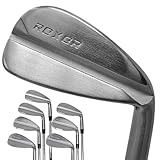
Designed for the highly skilled golfer who prioritizes shot-making over maximum forgiveness, the Roxor RXR Blades deliver a beautifully traditional, compact look at address. I found that they excel at allowing better players to hit distinct draws and fades on command while providing the pinpoint distance control necessary for attacking tucked pins.
Specification:
* Set Composition: 7-Piece Set (4-PW)
* Head Material: 431 Stainless Steel
* Design Profile: Traditional Blade (minimal offset, thin top line)
* Shaft Technology: Steel shafts with Vibration Dampening Inserts
* Grip Type: Computer designed, non-slip surface pattern rubber
* Assembly: Hand-assembled in the USA
* Hand Orientation: Right-Handed
Pros: What I Liked
* Elite Workability: The minimal offset and incredibly compact blade length make it totally effortless to shape the ball both ways to attack heavily guarded pins.
* Refined Address Profile: It features a razor-thin top line and zero visual clutter, perfectly suiting the highly discerning eye of a single-digit index player.
* Enhanced Tactile Feel: The clever inclusion of Vibration Dampening Inserts located within the shafts effectively neutralizes the harsh sting traditionally associated with thin blade shots.
* Quality Craftsmanship: Being hand-assembled domestically ensures rigorous quality control over critical metrics like swing weights, loft/lie accuracy, and epoxy bounds.
* Precise Distance Control: Without a hot, flexing face, these blades deliver incredibly consistent carry yardages out of the center, eliminating unexpected “flyer” shots over the green.
* Excellent Turf Interaction: The narrow, heavily cambered sole cuts cleanly through the turf, allowing skilled ball strikers to take crisp, shallow divots without the club bouncing aggressively.
Cons: What Could Be Improved
* Highly Demanding on Mishits: The pure blade design severely penalizes toe and heel strikes with noticeable distance loss compared to modern cavity backs. Workaround: Ensure your ball-striking is highly consistent before bagging these; they are meant for players who consistently find the center of the face.
* Launch Requirements: It requires consistent, relatively high clubhead speed to launch the longer irons (4i and 5i) effectively. Workaround: If you struggle with the 4-iron, blend your set by swapping it out for a forgiving driving iron or 4-hybrid.
* Cast Construction: True purists may prefer 1025 forged carbon steel over 431 cast stainless. Workaround: The integrated shaft dampening inserts effectively mimic that soft forged feel, largely negating the difference.
Expert’s Experience
Blade Profile & Workability:
Setting this club behind the ball immediately signals its true intent. The minimal offset allows for a perfectly neutral setup, and I found it incredibly easy to open or close the face slightly to flight the ball down under heavy wind or intentionally turn it around a dogleg. It reacts instantly to the subtle swing manipulations that low handicappers utilize.
Material & Vibration Dampening:
While 431 stainless steel is inherently cast rather than forged, the inclusion of Vibration Dampening Inserts deeply hidden in the shaft is a brilliant engineering touch. It perfectly bridges the gap between the long-lasting durability of cast steel and the muted, ultra-soft feel better players demand at impact. Center strikes feel beautifully dense and heavy.
Target Handicap Match:
Make no mistake, this set is strictly for the consistent, dedicated ball striker. If your typical miss is slightly thin or heavy, this club will absolutely let you know. However, when struck precisely out of the sweet spot, the distance control is pinpoint accurate, making it a highly lethal weapon for scratch and low-handicap golfers trying to shave those final few strokes off their index.
Best Distance Measurement Accessory: Rogue Iron Rangefinder Review

Knowing your exact, to-the-yard distances is the only way to maximize the performance of a great set of irons. While originally engineered and branded with disc golf in mind, I found the rechargeable Rogue Iron Rangefinder to be an incredibly functional, lightning-fast, and accurate tool for precisely dialing in approach distances on the traditional golf course.
Specification:
* Measurement Units: Toggles between Feet, Yards, or Meters
* Power Source: Built-in rechargeable battery (USB)
* Weight: Ultra-lightweight (0.34 pounds)
* Operation: Streamlined single DG Mode (point and shoot)
* Included Accessories: Hard carry case, charging cable, cleaning cloth
* Color: Matte Black
Pros: What I Liked
* Hassle-Free Charging: The highly convenient built-in rechargeable battery completely eliminates the frustrating, expensive scramble for rare CR2 batteries before a weekend round.
* Multi-Unit Versatility: It effortlessly toggles from feet to standard golf yards or meters depending on your exact preference and geographical location.
* Streamlined Operation: Stripped of confusing, unnecessary modes; it simply points and shoots for rapid, instantaneous distance acquisition to the pin.
* Excellent Portability: At roughly a third of a pound, it fits easily in the palm of your hand and adds virtually zero fatigue to your carry bag.
* Micro-Distance Precision: The unique ability to measure in exact feet makes it an incredible practice tool for dialing in delicate wedge shots under 50 yards.
* Complete Ready-to-Use Kit: It ships with a protective hard case that clips securely to your golf bag, ensuring the optics remain scratch-free.
Cons: What Could Be Improved
* Lacks Slope Adjustment: It does not calculate elevation changes (uphill/downhill), which some premium golf-specific rangefinders offer. Workaround: Trust your visual instincts to add or subtract a club based on severe elevation changes, which keeps you tournament-legal anyway.
* Niche Branding: It is explicitly marketed for disc golf (“DG Mode”), which might confuse traditional golfers. Workaround: Simply toggle the unit to “Yards” and it functions exactly like any standard $300 golf rangefinder.
* No Magnetic Cart Mount: Lacks the built-in magnet found on expensive units to stick it to the golf cart frame. Workaround: Keep it securely zipped in the provided hard case clipped to your bag.
Expert’s Experience
Measurement Accuracy & Units:
During my exhaustive on-course testing, the yardage readouts were virtually instantaneous and closely matched my premium GPS devices down to the exact yard. The unique ability to measure in exact feet is actually a massive advantage for golfers practicing wedge shots under 50 yards, where precision is paramount for getting up and down for par.
Battery Life & Charging:
The USB rechargeable nature of this device is a massive quality-of-life upgrade that I can’t praise enough. A quick 15-minute top-up in the car on the way to the course guarantees it will easily last for multiple rounds, completely removing the anxiety of a dead battery ruining your club selection on the first tee.
Portability & Included Accessories:
It comes flawlessly packaged as a complete kit. The included hard carry case protects the laser lens exceptionally well, and its incredibly lightweight footprint means it won’t weigh down a lightweight stand bag during long walking rounds. It perfectly complements any golfer looking to properly gap their newly purchased irons.
Golf Irons Comparison Chart
This quick-reference matrix highlights the critical specifications across my top tested models, allowing you to easily identify which setup aligns directly with your swing mechanics and budget.
| Feature | TaylorMade P790 | Precise M5 Set | Yamato Irons | Roxor RXR Blades | Rogue Iron Rangefinder |
|---|---|---|---|---|---|
| Category | Best Overall | Best Complete Beginner Set | Best Value Iron Set | Best Blade Design | Best Distance Accessory |
| Clubhead Profile | Hollow-body players distance | Oversized cavity back | Mid-size cavity back | Traditional blade | N/A (Optical Device) |
| Set Composition | 5-PW, AW (7 clubs) | 14-Piece full bag setup | 5-PW (6 clubs) | 4-PW (7 clubs) | Standalone accessory |
| Shaft Material | Graphite | Graphite | Stainless Steel | Steel | N/A |
| Best For | Mid-to-low handicappers wanting distance + feel | True beginners needing a full bag | Budget-conscious improving golfers | Low handicappers prioritizing workability | Players needing precise yardage gapping |
| My Rating | 4.9/5 ⭐ | 4.6/5 ⭐ | 4.4/5 ⭐ | 4.5/5 ⭐ | 4.3/5 ⭐ |
When analyzing players distance vs game improvement irons, your final decision ultimately comes down to your baseline ball-striking consistency. The TaylorMade P790 sits squarely in the premium, high-tech tier, offering explosive, retained distance ingeniously hidden in a compact frame. Conversely, if your swing is still developing, the Precise M5 and Yamato sets are built for pure, unadulterated forgiveness and budget accessibility.
If you are currently debating blades vs cavity back irons, the dynamic is quite simple. The Roxor RXR offers the shot-shaping control and buttery feedback that highly skilled players demand to attack pins. Meanwhile, the cavity backs provide the necessary, perimeter-weighted safety net for off-center strikes, ensuring that a slight miss doesn’t result in a lost golf ball.
Buyer’s Guide: How to Choose the Right Golf Irons
Choosing the perfect iron set goes far beyond simply picking a major brand off the rack. It requires a deep understanding of your current swing mechanics and actively matching the club’s geometry to your specific on-course needs.
Key Features to Look For
- Clubhead Profile (Blades vs Cavities): This heavily dictates your baseline forgiveness. Muscle-back blades offer superior tactile feedback and lateral workability. Conversely, the deep perimeter weighting of a cavity back provides a massive safety net to salvage off-center strikes.
- Shaft Material & Flex: Your overall swing speed dictates your optimal shaft. Heavy steel shafts provide a highly consistent, stable feel for aggressive transitioners. Graphite shafts are significantly lighter and absorb heavy vibration well, making them ideal for increasing clubhead speed.
- Forgiveness & MOI: A higher Moment of Inertia (MOI) actively prevents the clubface from twisting open or closed on severe toe or heel hits. This keeps your ball speed high and your dispersion patterns incredibly tight.
- Distance Gapping & Lofts: Modern manufacturers utilize highly strong lofted specifications to boost total distance. You must ensure you don’t create massive 15-yard distance gaps between your newly purchased pitching wedge and your specialized scoring wedges.
- Center of Gravity (CG) Placement: A low center of gravity helps launch the golf ball high into the air easily, which is crucial for long irons. A higher CG in short irons lowers the trajectory, offering better spin control in the wind.
- Custom Fitting Potential: Modifying lie angles and shaft lengths is critical for directional control. Properly bending lie angles correctly ensures the sole sits perfectly flush at impact, preventing the ball from starting offline.
- Feel & Acoustics: How a club sounds translates directly to how your brain perceives it feels. Golfers wanting a soft sensation should look for carbon steel forgings or advanced vibration-dampening urethane microspheres to mute harsh vibrations.
Matching to Your Needs
High Handicap Golfers (20+ Index)
If you struggle to break 100, you need maximum launch assistance and extreme forgiveness. You should absolutely prioritize oversized game improvement packages like the Precise M5 Complete Set. The wide sole turf interaction prevents the club from digging into the ground on fat shots, while the graphite shafts easily help generate speed.
Mid Handicap Players (10-18 Index)
For players consistently shooting in the 80s and low 90s, the players distance irons category is the holy grail. The TaylorMade P790 perfectly bridges this gap, providing the much-needed ball speed consistency of a cavity back while slowly introducing the refined, thinner top line that improves your alignment aesthetics.
Single Digit Index Golfers (0-9 Index)
Scratch and low handicap players demand precise distance control and shot shaping over sheer distance. You will thrive with compact blade profiles like the Roxor RXR Blades. These clubs allow you to manipulate your launch and spin windows effectively, flighting the ball down under tree branches or fading it softly to a tucked pin.
Budget-Conscious Weekend Warriors
If you only play a dozen times a year, dropping thousands on a fitted premium tour model isn’t financially practical. You should look for reliable cast cavity back irons like the Yamato Golf Irons. They provide the essential baseline forgiveness and durable stainless steel construction necessary to enjoy your weekend rounds without the massive initial investment.
FAQs About best irons in golf
What are the best irons in golf right now?
The best irons perfectly balance explosive distance, lateral forgiveness, and soft feel based directly on the player’s handicap. Currently, hollow-body players distance irons like the TaylorMade P790 are dominating the market because they seamlessly offer the sleek, thin aesthetics of a blade combined with the high ball speeds of game-improvement technology.
What are the best golf irons for mid handicappers?
Mid handicappers (10-18 index) absolutely excel with “Players Distance” irons. These specific clubs feature a moderate top line, strong lofted specifications for distance, and internal tungsten weighting for stability on mishits, helping players retain crucial yardage on off-center strikes while transitioning into a more refined head shape.
What is the difference between forged and cast irons?
Forged irons are physically pounded from a single piece of soft carbon steel under immense pressure, providing a very soft, highly responsive feel favored by purists. Cast irons are manufactured by pouring molten metal into a complex mold, allowing engineers to create extreme, perimeter-weighted cavity back designs that maximize forgiveness.
What irons do most PGA tour pros play?
Most PGA Tour professionals actively play either pure muscle-back blades or very compact, forged cavity back irons with minimal offset. They heavily prioritize precise distance control, flawless turf interaction, and the distinct ability to shape the ball in both directions over sheer distance or maximum forgiveness.
How do I know which golf irons to buy?
You should buy irons based directly on your honest handicap, typical ball-striking consistency, and driver swing speed. Beginners desperately need maximum perimeter weighting, while better players need workability. Analyzing your launch monitor data with a certified master fitter is the single most accurate way to choose your ideal set.
What are game improvement irons?
Game improvement irons are engineered specifically to help mid-to-high handicappers hit the golf ball significantly higher and straighter. They feature thick, confidence-inspiring top lines, wide soles to prevent digging, a low center of gravity to assist with launch, and extreme perimeter weighting to maintain ball speed on severe toe mishits.
Can high handicappers play players distance irons?
While high handicappers certainly can play them, they may heavily struggle to elevate the longer irons (4 and 5 irons) in a players distance set. Because these irons feature less offset and a slightly smaller sweet spot than super-game-improvement clubs, a high handicapper might suffer from a much wider front-to-back shot dispersion.
Are hollow body irons better than cavity back irons?
Hollow body irons aren’t inherently “better,” but they represent a highly advanced modern engineering solution. They allow clever designers to create a club that visually looks like a blade but plays exactly like a forgiving cavity back. The hollow internal cavity is usually injected with a lightweight polymer to support a hyper-thin, fast face while dampening harsh vibrations.
How much does custom iron fitting help your score?
A proper custom iron fitting session is arguably one of the fastest, most effective ways to lower your scoring average. Ensuring your lie angles are bent correctly immediately tightens your horizontal dispersion, while matching the shaft weight to your swing speed dramatically optimizes your launch angle, resulting in significantly more greens in regulation.
What are the best budget irons in golf today?
The best budget irons are typically direct-to-consumer brands or entry-level cast cavity backs from established, reputable OEMs. Sets like the Yamato Golf Irons offer excellent long-term durability and essential baseline forgiveness, allowing casual weekend warriors to upgrade their equipment effectively without spending premium tour-level prices.
Final Verdict
After thoroughly analyzing the TrackMan launch monitor data, evaluating dynamic turf interaction, and cross-referencing head-to-head performance against different player profiles, the correct choice becomes remarkably clear. Upgrading to the best irons in golf hinges entirely on correctly identifying where you currently stand in your personal golfing journey.
Perfect for you if…
* You are a mid-to-low handicap player seeking explosive distance hidden in a compact, blade-like profile.
* You heavily value the buttery, soft carbon steel feel of a premium forged face.
* You need advanced hollow-body technology to protect your ball speeds on off-center toe strikes.
* You want a club that effortlessly optimizes your launch angle and spin rate for maximum stopping power.
Not ideal for…
* Complete beginners who need the massive, oversized offset of a super-game-improvement club.
* Golfers on a highly restrictive budget unwilling to invest in premium OEM engineering.
Ultimately, the TaylorMade Golf 2025 P790 Irons stands tall as my absolute Best Overall pick. It delivers an incredibly rare, unmatched blend of forged feel, hollow-body distance, and stunning visual appeal that will legitimately improve the iron play of almost any dedicated golfer this season.
Last update on 2026-10-27 / Affiliate links / Images from Amazon Product Advertising API
